
ANALYSIS: 5 things we learned from Eurobike 2026
Europe’s flagship bicycle show drew barely half the trade visitors of 2025, and several big names stayed away altogether. But the ideas crammed into the half-empty halls show where the industry’s next battles will be fought.Werner Müller-Schell reports…
On the first day of Eurobike 2026, a saxophonist played at the west entrance of Messe Frankfurt — a strangely fitting soundtrack for a show that felt quieter, smaller and less urgent than in the past. It was a brief scene, but one that seemed to capture a broader feeling around the fair: Eurobike was still there, still professionally staged and still full of products, but no longer quite the unavoidable industry gathering it once was. The absence of many big names and the noticeably calmer halls made that hard to ignore. But reducing the week to empty aisles would miss the point: beyond the subdued atmosphere, Eurobike also revealed where the bike business is heading next. Here are five things the week told us about the future of the industry.
1. Eurobike is fighting for survival
The numbers are hard to ignore. Around 800 exhibitors from 44 countries still showed up, but only 15,130 trade professionals walked the halls — down from 31,270 in 2025. Festival-day enthusiasts told the same story, collapsing from more than 30,000 to under 9,000, and several major brands stayed away entirely. Organiser Fairnamic put a brave face on it, pointing to a sharper audience (71% executives, up from 58%) and 440 million in media reach. The quality, in other words, was there – the volume, however, was not. And the timing could hardly be worse: with German industry federation ZIV launching a rival show, “Towards Tomorrow,” in 2027, many brands may soon have to choose between two events. Against that backdrop, Eurobike’s shorter, strictly B2B-focused 2027 relaunch reads less like ambition than like a fight for relevance.

2. The industry is under pressure — but not without hope
Germany counted 90.6 million bikes and e-bikes in 2025, a quarter more than a decade earlier. Yet revenue fell 7.7% to €5.85 billion. Data from the Global Bicycle Purchasing Index, presented by IFH Cologne’s Dr Ralf Deckers, confirmed the squeeze: 70% of respondents expect higher purchase prices, 61% see rising uncertainty, and 55% brace for continued margin pressure. The brighter note came from a study by Women in Cycling Germany and German market research company IFH: products built around safety, comfort and everyday practicality for female riders could unlock up to €950 million in additional revenue — a market the trade has barely begun to address.
 3. A new generation of motors is coming for Bosch
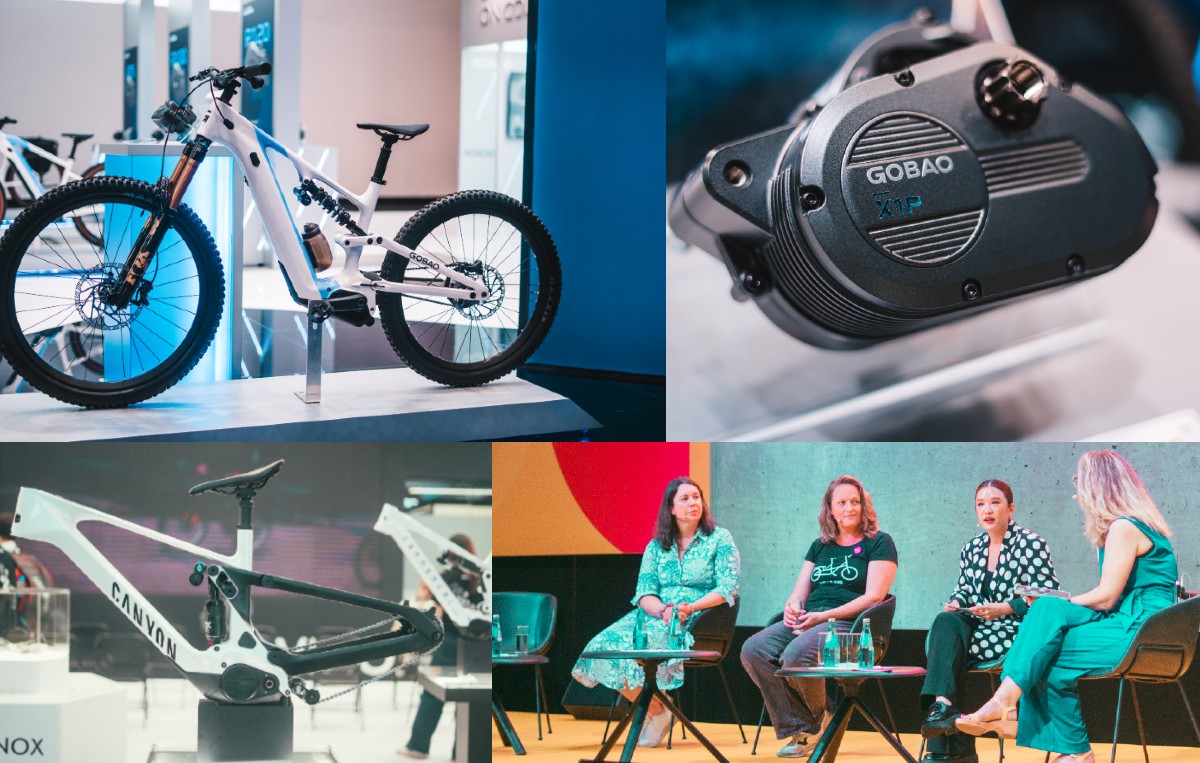
The most palpable energy surrounded the countless innovations in drive systems, where especially Chinese newcomers are rewriting the rules — starting with raw torque. Both Gobao’s “X1P” and Avinox’s “M2S” are now rated at a muscular 150 Nm, unthinkable on a production eBike just two years ago. All that power needs feeding fast, and Gobao’s Supercharger pushes a remarkable 30 amps — against roughly 12 for the fast chargers from Bosch and Avinox — taking a 750 Wh battery from 10 to 80% in under 20 minutes from a fan-cooled unit weighing just 1.2 kilos. Both the charger and the “X1P” motor reach series production in early 2027. Munich’s bicycle brand Hepha made a similar pitch with its “Urban X” concept, claiming a 0-to-80% charge in 17 minutes — short enough, it argued, for retailers to put charging points outside their shops.
4. Gear shifting is yesterday’s problem
Another lesson from the show floor is that the bike is increasingly making the decisions for the rider. On the Avinox stand, the company’s Smooth Shift system read cadence, speed and load to select the gear on its own, and changed it cleanly even while the bike stood still. The “MG Concept” — the brand’s headline drive unit – goes further still. It is claimed to shift in under 0.1 seconds, can be operated manually or fully automatically through cadence- and AI-based modes, and runs a single-speed chain or belt that dispenses with the rear derailleur and cassette entirely. According to Avinox, the internal gearbox requires no servicing for the life of the bike. Taken together, these systems raise a question that ran through much of the show: in an increasingly automated, motorised world, is there any real reason for the rider to keep shifting at all?
 5. Cycling becomes smarter than ever
If one theme tied the show together, it was digitalisation. Canyon’s futuristic stand set the tone with the “Stingr” smart helmet, whose visor projects speed, power output and hazard warnings, and the Predict system, which flags unseen risks through a blinking handlebar. Its “Roadlite:ON V2X” claims to be the first production bike that communicates with V2X-equipped cars. Meanwhile, Avinox took the Eurobike Award in the Digital Solutions category for its “Smart Heart Rate Control System”, which tunes pedal assist to hold riders inside a chosen heart-rate zone. Add automatic seatposts, keyless smart locks and electronic mini-pumps — and the bicycle is quietly turning into a connected device.
Looking Ahead to 2027
Eurobike 2026 was, in the end, a study in contradiction: a show full of genuine innovation, staged in halls that too often felt half-empty. The organisers are betting that less is more. The 35th Eurobike will run at Messe Frankfurt from 1 to 3 September 2027 — shorter, strictly B2B-focused, and relocated to a new section of the grounds. Whether that sharper format wins back the brands that stayed away — or simply hands momentum to ZIV’s rival “Towards Tomorrow” — is the question Frankfurt now has a year to answer.




