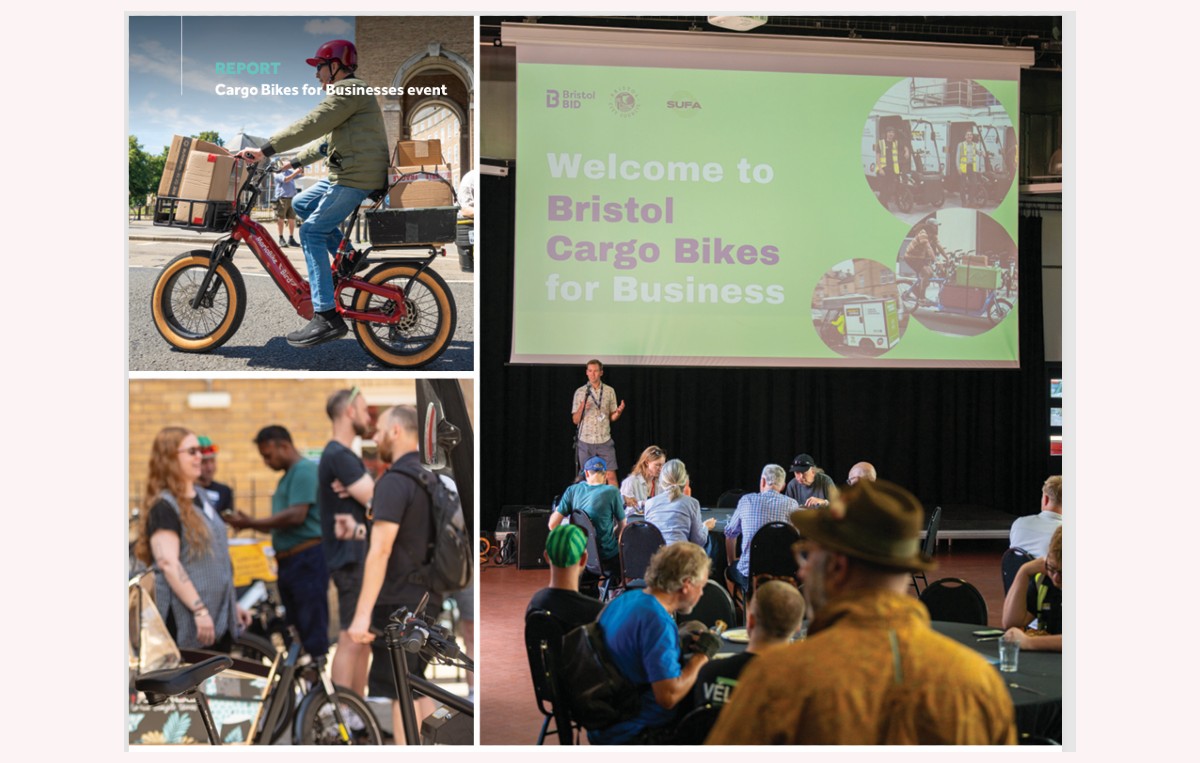
Report: Bristol’s Cargo Bikes for Business showcases swapping vans for cargo bikes
It can be done and it is being done – and there are some city councils who want to make it easier… for businesses to switch to cargo bike deliveries. Jonathon Harker sits in on Bristol City Council and BID’s event to help push the cargo bike for business transformation…
A metal box in a municipal car park in Bristol is a long way away from the glamour and romance of the Tour de France, say, which happened to be underway during CIN’s visit to the multi-storey parking spot. It’s not the kind of location that immediately makes you think cycling, or the kind of place you expected to find yourself when you were initially dazzled by the lights of the cycling industry and leaped into the trade in the first place.
 So why was your humble reporter happily lurking in a concrete car park and gazing at a metal box? Because it represents a very different side to cycling than le Tour. It’s a side the industry has only scratched the surface of so far: the use of bikes by businesses for last mile logistics. I piggybacked on a session where knowledgeable people asked sensible questions about the metal box (aka Bristol’s first Consolidation Hub), where operators will collect and sort goods from different suppliers, consolidate them and then send them off for delivery on cargo bikes: What was the insurance situation? What facilities were available for operators? Was there enough height clearance for a Transit style van to drop off goods at the hub? The loading bays, fire safety, lockable battery recharge points…
This is very definitely the practical, a-to-b world of cycling logistics. We were gathered in aid of Bristol City Council and Business Improvement District (BID) joint event ‘Cargo Bikes for Businesses’. The aim was simple, to show businesses that it can be done, it is being done and Bristol City Council wants to make it easier to do, for organisations and businesses to make the switch away from cars and vans to make their deliveries.
Kicking off with a ride around Bristol on cargo bikes, trikes, EAVs (electric assisted vehicles) and more, the event switched to a networking session connecting businesses with cargo bike brands, service providers and organisations which are trying to help. That was followed up with a few short sharp talks.
One of the killer speeches came from a local business that was saving money by operating its own cargo bike to make deliveries between its sites in and around the city. Are cargo bikes the fastest way to get goods around a city? Possibly not. But are they the most predictable? Chris Swift, Director of Spicer & Cole – a four-branch
café business – said so, adding that access is easier than with vans, in some cases right up to a front door even in pedestrian areas. Swift explained how the business had experimented with a third-party delivery company using cargo bikes initially, before buying an EAV (50% funded by a grant from Bristol City Council). Now the business is a convert. Food damage has virtually been eliminated during transit, the vehicle is also seen as a positive billboard for the business. And that crux point, that hopefully made businesses sit up and listen closely, was that not only are cargo bike deliveries far more predictable, they are also cheaper than using a van.

Where does your bike shop and workshop fit it?
You might be one of the bike dealers who have been sceptical of the potential the last mile logistics sector could have for your business, or maybe not given it much thought. Let’s face it, you didn’t get into the trade to think about metal boxes in municipal car parks, it was more likely the glamour of le Tour or the thrill of hurling yourself down a mountain trail that lured you into the trade. But another killer speech was on the way, delivered by a bike shop and workshop.
Dexter Robinson of Holy Spokes, an independent workshop, delivered a speech helping businesses consider what kind of cargo bike they need, but also highlighted the fact that it was possible to operate a workshop business for the traditional leisure cycling market as well as offering fleet servicing for the growing cargo bike market. Working across those two sectors, Holy Spokes is adept at keeping standard bikes on the road as well as cargo bike and complex custom machines, be that an Iceni cargo trike, EAV or something else. The firm also emphasised the need to service the bike regularly, likely to keep cargo bike operation cheaper in the long run.
Speeches also came from Holley Swanwick, Project Manager at Bristol City Council, who explained how the micro consolidation hubs will help Bristol hit its Net Zero targets. Tom Swithinbank from Bristol BID explained how Bristol is walking the walk, as well as talking the talk, for instance how its gardeners are using cargo bikes to transport tools when caring for the city centre green spaces. Lee Pugh, co-chair of the Sustainable Urban Freight Association (SUFA), also spoke about the broader
support for the sector and its aim to work towards cleaner, fairer and more efficient deliveries.
It was the first event of its kind from Bristol City Council, but conversations indicated it probably won’t be the last. It was a pro-business, pro-net zero, pro-cycling industry event that hoped to be an eye-opener to the possibilities that cycling logistics can deliver.
Photographs credited to: Andre Pattenden