
Yamaha eBike on heritage and its evolved B2B approach
Yamaha has eBike business heritage, but how does it stand out in a field of increasingly powerful competition? Mark Sutton sought to understand the B2B structure and the Japanese household name’s plans for 2026 and beyond, speaking with Yamaha’s Fabia Marzola…
It’s perhaps not widely enough known that Yamaha has been in the eBike business longer than any other brand, that is, if we are talking about modern, pedal-assist eBikes. Better known as a giant of the motorcycle world, it was 1989 when the Japanese business started to dabble with the idea of placing a motor on a bicycle, achieving the world’s first production electric bike in 1993.
The business pioneered the use of a speed sensor on a bicycle, set against a bulky mid motor and paired to a very large and weighty lead acid battery hovering over the rear wheel. The result was a swept-back handlebar shopping bike with wildly disproportionate tubing on the downtube and seat tube. Nonetheless, the modern electric bike era really began here, and for that, we are all grateful.
As we all are well aware by now, heritage is one thing, staying power quite another, and the Yamaha eBike division of the 2020s has had plenty in the way of success stories and a few market-relevant hiccups too. Another piece of little-known trivia is that in 2024, it was a Yamaha Wabash gravel eBike, ridden by a round-the-world touring cyclist and motorcyclist, plus long-time Yamaha ambassador Nick Sanders, that scored the very first global circumnavigation on an electric bike. By the way, Nick was in his mid-60s when he achieved that feat, proving that you’re never too old to go big with the help of an electric bike.
Nick’s bike made it all the way around, but in light of batteries not being welcomed on board by airlines, a logistical feat of global battery sourcing on each new continent came into play. For Yamaha, which is a global powerhouse and brand name, this was no trouble. Registering up to 170-miles of pedal-assisted riding per day and covering 19,000 miles, Nick and his Yamaha Wabash made it around the globe by leaning on only a 500Wh battery and Yamaha’s 70Nm PW-ST motor. Again, the Yamaha eBike motor is written into the record books.
Here is where the story diverges in terms of the hard goods, however. The Wabash, as with all other Yamaha electric bikes that did exist for a few years until relatively recently, is no longer in
production. The wholesaling of Yamaha-brand eBikes halted at the end of 2025. On the reverse side of the coin, Yamaha showed its intent to remain and grow with the acquisition of the Brose
eBike division in 2025, which will now integrate into the European business.
Sticking to its specialities
Speaking to Cycling Industry News, Yamaha’s Fabia Marzola tells us: “Now Yamaha is sticking to its specialities and keeping things simple, the brand tells CIN the only location where you can buy
Yamaha-branded electric bikes is in our native Japan. Otherwise, in Europe, we are wholly focused now on the production of electric bike motors and with a limited and focused range. We launched our own electric bikes really to test the market many years ago, but decided to focus our efforts and not bother our OEM customers with competing products.”
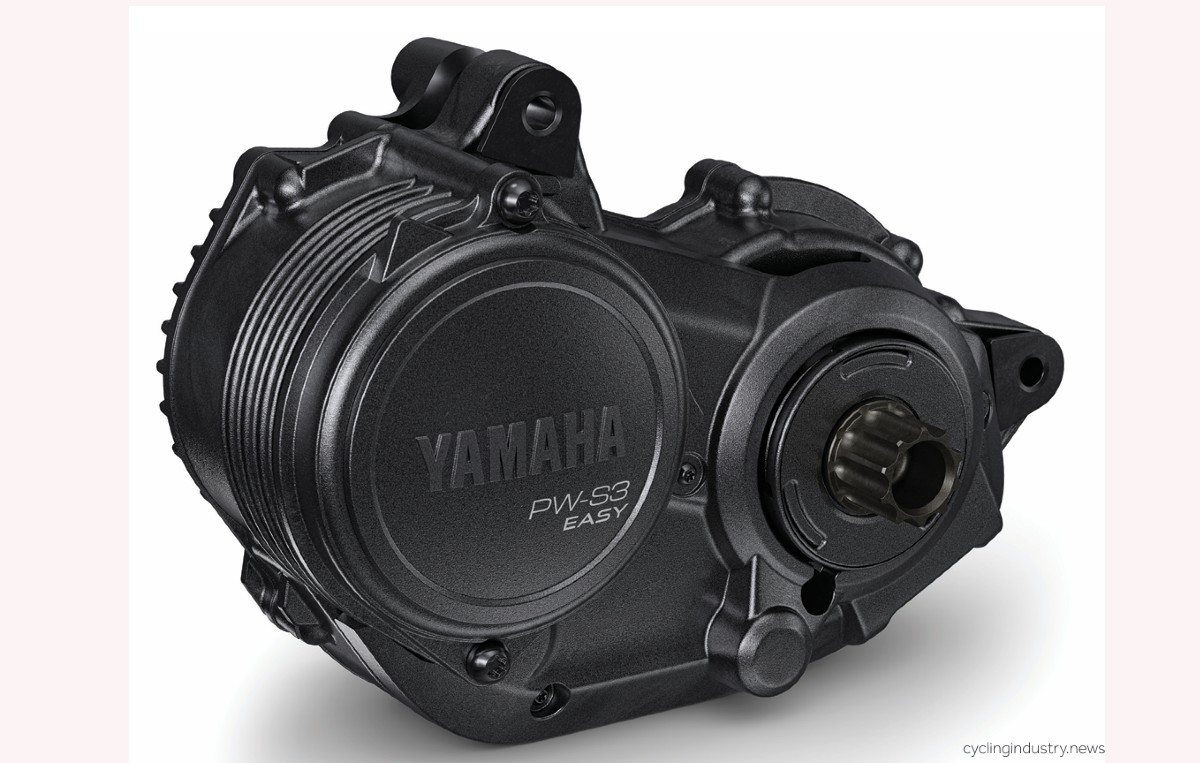
Where there is suddenly ample competition in the electric bike motor space, Yamaha is sticking to its specialities and, actually, keeping things very simple. There are only a trio motors presently in production, which are the mountain bike-suited PW-X4 with its 100Nm torque and 750W power peak, all enclosed in a slimline magnesium casing. At 2.6kg all in, this sporty drive unit is keeping the pace alongside the best of the rest and has found fans in European bike manufacturer Raymon. Then there is the PW-S3, city and trekking drive unit, which turns out an impressive 75Nm, making it a standout for torque support in this sector. Some of these motors have been spotted attached to Hero Cycles’ InSync brand eBikes, as well as with Decathlon’s eBikes. Finally, the PW-Link 48V drives are the next-generation modular units built for interchangeability within the PW Link ecosystem, which has motors, batteries and displays. It has things like Zero Cadence Technology, which delivers strong low-speed support, plus it is designed with third-party integration in mind, opening up the field of play to manufacturing partners to get creative. There is the option of either 560Wh or a whopping 840Wh PW-link 48V battery spec, gifting brands dual pricing and range options for their customers.
So, it is a consolidated and focused approach in a competitive arena. With manufacturing hosted in France, Japan and Taiwan, the firm is drawing on decades of electronics knowledge and expertise from its robotics division to precision engineer a product fit to compete in 2026. The French production line, which launched to much fanfare two years ago, is just about wrapping up production of the previous generation’s 36V S2 motors and is soon to convert the production line to be ready for the next generation and has the scope to scale up when Yamaha deems the eBike market’s growth trajectory is firmly back on track.
 Stabilising demand
Fabio says of current order patterns, “Demand for electric bike motors was stabilised in 2025, especially in Germany. All in all, the market is settling at around five million units per year here. The arrival of DJI (now Avinox) created a lot of noise, and it seems they onboarded lots of new customers very quickly. It showed that if you come to the market with the right product, there is space for you Yet Avinox is attacking the tip of the pyramid, but for Yamaha, though we are also not pitched as a cheap product, we recognise that the majority of the volume is the electric bicycle below €3,000.”
Another thing recognised by Fabio and Yamaha is the growing noise around eBike motor power. In acknowledging the progress of Motinova and Gabao, to name two more, Fabio says that Yamaha is striking a balance in its metrics to protect trail access and ensure responsible use of its motors.
On this, Fabio shares the time-tested Yamaha perspective. “Power ceilings such as 750W are frequently discussed within the industry and are generally sufficient to meet the performance demands of most terrains, when combined with optimised torque curves, calibrated assist algorithms, and the appropriate gearing. “We believe the long-term success of the category lies not in pursuing higher peak power figures, but in delivering balanced ride characteristics, refined power delivery, optimal thermal management, higher battery efficiency, system integration durability, and rider confidence. Sustainable growth will come from creating bikes that inspire loyalty through overall ride experience, not just motor output.
Back to pricing, and it’s clear that there is a thoughtful approach to value weighted against performance coming through the next generation motors and, as such, the motor systems are now moving from 36V to 48V, as well as beginning to factor in some significant user interface upgrades. Fabio explains: “How the user interacts with the bicycle is via an app designed by us. Within that, there are features like geolocation, user authentication, rider and eBike statistics, health data, plus range and battery metrics. Overlaid are several layers of cybersecurity, inclusive of a system that can automatically disable the system if the battery is missing. In the beginning, only the bicycle dealer can authorise a system to work together, so this first user’s security profile happens at the point of sale, all by the bicycle shop activating a QR code. Then the end-user gets an authentication key for the system.”
With 30 years’ experience in the field and being a Japanese company, Fabio says that Yamaha takes a lot of pride in scoring way below the average for industry claims against its hardware, which is especially important on account of recent bombshell research from the University of Delft that shows that eBike motors are having a cluster of failures at between 16,000 and 20,000km, often down to simple things like a bearing failure. At this point, so found the research, 43% of users would likely dispose of the entire electric bike, rather than seek a fix. That, obviously, is something for motor makers to give deep consideration when it comes to quality control and serviceability.
On this note, Fabio concludes: “We started in 2025 with the deployment of a direct-to-dealer after-sales and service structure. We started in France last year and will now expand to other countries. A dealer working on any Yamaha system will be able to access our knowledge directly via a detailed online portal, where they can access troubleshooting, make claims on service parts and access the warranty process. Dealers can’t yet repair the motor themselves, but we are now looking at refurbished motors at a more reasonable price as part of our offering. In the motorcycle world, you can open the motor up to change parts, so that’s the vision once the broad network is trained.”




