
Bicycle Association calls for urgent implementation of eBike fire-tackling eBike Action Plan
The Bicycle Association has launched its eBike Action Plan for Government, pitched as a comprehensive plan to tackle the issue of fires attributed to unsafe eBike batteries – and is calling for its immediate implementation.
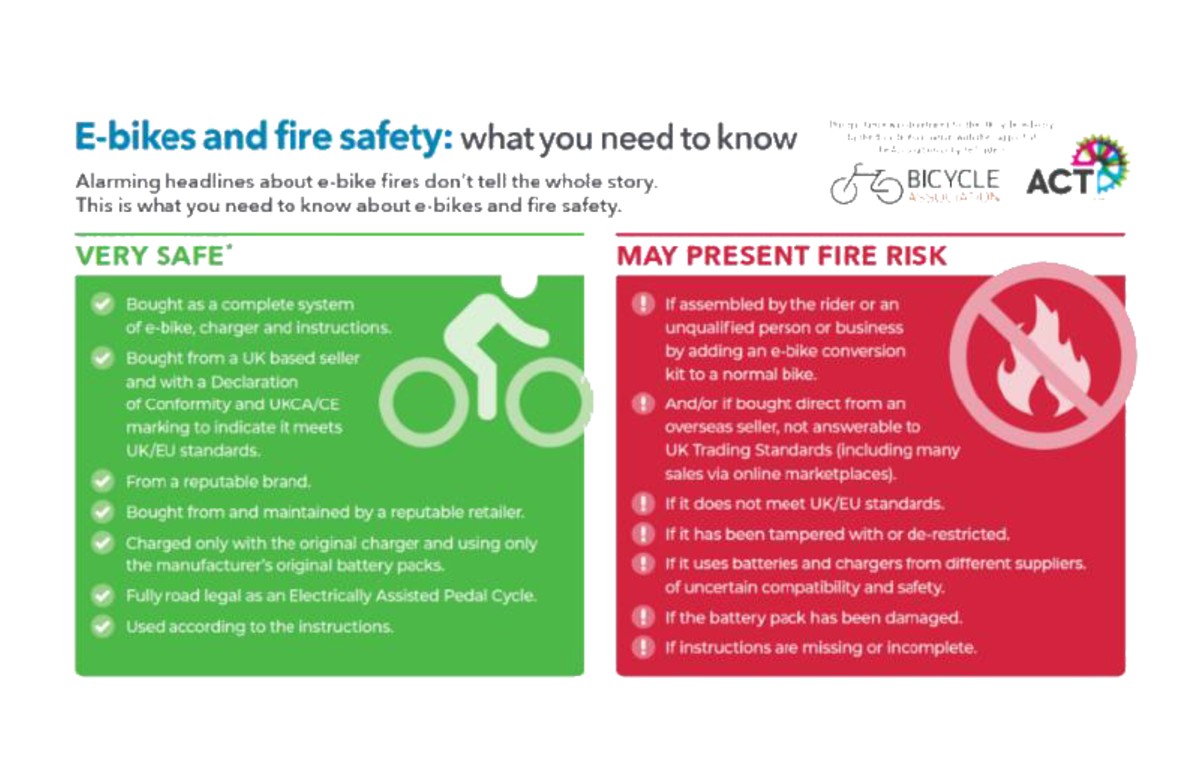
The 22-page eBike Action Plan plan emphasises, right from page 2, that eBike-related fires are largely caused by unsafe or incompatible products, often sold direct from overseas and marketplaces. It also underlines the point that riders in the ‘gig economy’ – are among the key drivers for these high risk products.
But the report goes further with, as its name suggests, practical steps the government can and should take to meaningfully address the issue of eBike fires and their underlying causes. Those steps are summarised as:
- Resource increased enforcement of current regulations
2. Address high risk imports, especially via online marketplaces
3. Address ‘gig economy’ structures, responsibilities and incentives
4. Close legal loopholes for non-legal and de-restricted eBikes and kits
5. Strengthen battery-specific regulations
6. Educate the public about responsible purchase and use
The BA’s eBike Action Plan comes amid an increasingly fast-moving situation that has seen insurers and landlords operate blanket eBike bans or install huge premiums. It has also seen Transport for London ban non-folding eBikes on its transport network, a palpable blow for the sector which is, for all intents and purposes, under attack from questionable and often non-legal product causing reputational damage to the industry and related livelihoods, as well as actual risk to life.
The BA’s action plans adds that, until the measures listed above take full effect the Government (all departments) is urged to help safeguard the legitimate e-Bike sector by:
1. Consulting the responsible eBike industry at the earliest possible stage before any interventions are finalised
2. Ensure that all official communications strongly emphasise the difference between safe and legal eBikes, and non-legal products often incorrectly described as eBikes.
3. Work, not least by supporting the industry initiatives detailed below, towards ensuring that any access or usage restrictions are applied only to unsafe eBikes, and ensuring that wherever possible a national approach is taken (rather than a patchwork of local decision-making)
The plan goes on to note the UK cycling industry is already taking action to help consumers and other stakeholders (including premises managers and transport operators) recognise reputable, safe eBikes as opposed to high risk products. These actions include:
1. Establishing the voluntary “BA register of safety-audited eBike brands” to highlight to consumers brands whose safety-related policies and quality processes have been independently audited
2. Establishing the “E-bike Positive Responsible Retailer Pledge” to identify shops committed to suppling only safe, legal eBikes, safe spare batteries and chargers, and delivering safe repairs.
3. Publishing accessible guidance to help consumers buy safe and charge safe – and to distinguish between very safe, legal and reputable products and higher risk devices.
4. Engaging actively with key stakeholders including Government, strategic and local transport authorities, public transport operators and organisations, the insurance and underwriter industries, international standards development bodies, fire and rescue services, safety charities and more.
“These tragic incidents must be stopped, and that requires decisive action which goes well beyond technical regulations,” said Peter Eland, Technical & Policy Director at the Bicycle Association. “We need Ministers and Government departments, especially DfT, DBT and the Home Office, to work together to properly regulate both online marketplaces and gig economy food delivery operators, so that those sectors take real responsibility for the unsafe products supplied through their platforms or used to deliver their services.
“We also need Government action to take non-legal e-bikes off sale, and off the road. Legitimate, road legal e-bikes are known formally as EAPCs – Electrically Assisted Pedal Cycles – and these are rigorously defined in law to be similar in performance to normal cycles. EAPCs from reputable suppliers are enjoyed safely by hundreds of thousands of people in the UK, and millions worldwide, for transport and leisure.
“In contrast, the throttle-controlled, high-speed vehicles which are often reported as “e-bikes” in connection with unsafe riding, or even use in crimes such as phone-snatching, are not legitimate e-bikes at all – they are illegal e-motorcycles. Government must close the legal loophole which allows such vehicles – and the conversion kits often used to create them – to be sold legally. Taking these products off the market would contribute to fire safety, road safety and help tackle the criminal use of high-speed unregistered e-motorbikes.”
The Bicycle Association’s Executive Director, Steve Garidis, said: “Even the safest, fully legal e-bikes are being seriously reputationally damaged by association with fires in unsafe products completely beyond the UK industry’s control. The legitimate e-bike category in the UK is at serious risk as a result. E-bike sales have fallen significantly in recent years, in stark contrast to the worldwide trend, as users face repeated headlines about e-bike dangers, and consequent blanket restrictions on access and insurance.
“Our experts have been working on this issue intensively for years, working mostly behind the scenes with Government, regulators, fire and rescue services, the insurance sector, transport operators and many other stakeholders to explore possible solutions and to limit the damage to the reputable e-bike sector.
“We’ve summed up our understanding from years of work in this action plan. Now, on the three main points above we urge Government to act urgently – to prevent more tragic incidents and to safeguard tens of thousands of green jobs in the UK e-bike industry which otherwise has so much potential to grow, and to secure the future of this healthy, enjoyable and low-impact form of transport.
“Companies in the legitimate UK cycle industry take full legal responsibility for the safety of the products they supply. We think it’s high time that the online marketplaces and gig economy delivery companies take on that same responsibility, and that sales of non-road-legal e-bikes are banned.”




